
Why Weeds Keep Coming Back in Your Yorkville, Oswego, or Plainfield Lawn (Even After You Treated Them)
You sprayed the dandelions. You pulled the crabgrass. They're back anyway. Here's why weeds keep returning to western suburb lawns — and how to actually stop the cycle.
The Real Reasons Weeds Return Year After Year in Western Chicago Suburb Lawns — and How to Actually Stop the Cycle
You sprayed the dandelions in April. You pulled the crabgrass in July. You paid for a weed treatment last spring. And here they are again, staring at you from the lawn this year like nothing ever happened.
If it feels like you're fighting the same battle every season, you're not imagining it. Weeds keep coming back in lawns across Yorkville, Oswego, Plainfield, Shorewood, and Naperville for reasons that have almost nothing to do with the weeds themselves — and almost everything to do with the underlying conditions that keep inviting them in.
Killing the weeds you can see is only step one. Understanding why they keep returning is what actually breaks the cycle.
Here are the five biggest reasons weeds come back — and what to do about each one.
Reason 1: The Seed Bank in Your Soil
This is the one homeowners almost never think about, and it changes everything.
Every square foot of your lawn contains anywhere from several hundred to tens of thousands of viable weed seeds sitting dormant in the soil right now. Some can stay viable for 5 years. Some for 40. Some — like common mullein and certain thistles — for over 80 years. This underground reservoir is called the weed seed bank, and it's the reason a lawn you've treated all season can still explode with new weeds the following spring.
Every time you pull a weed, mow one that's already gone to seed, or leave bare patches exposed to wind and birds, you're adding to the bank. Every time crabgrass matures and drops seed in August — which it does prolifically — you're loading up next year's problem.
You can't eliminate a seed bank. What you can do is stop feeding it, and prevent the seeds already there from germinating.
What actually works:
Never let weeds go to seed. Mow before dandelions puff, before crabgrass heads out, before clover flowers mature. One un-mowed weed can produce thousands of seeds.
Fill bare spots immediately with seed or sod. Bare soil is a landing pad for wind-blown seed and a perfect germination bed.
Pre-emergent herbicides stop the seeds already in your soil from sprouting. Without pre-emergent, you're playing whack-a-mole with a seed bank that will always win.
Fall aeration and overseeding thickens the turf canopy so light can't reach the seed bank — many weed seeds require light to germinate, so a dense canopy is a passive form of weed control.
Reason 2: Thin Turf
This is the single biggest reason weeds win.
Weeds are opportunists. They don't invade healthy, dense lawns — they invade the gaps. Every bare spot, every thinned-out area under a tree, every wear pattern from the dog running along the fence, every dead patch from summer stress becomes an open invitation. Weed seeds need three things to germinate: light, moisture, and space. Thick turf denies them all three.
If your lawn is thin, no amount of weed treatment will solve the problem long-term. You'll kill this year's weeds and next year's will fill the same gaps.
Thin turf is especially common in the western Chicago suburbs for a few reasons:
Builder-grade subdivisions leave lawns with poor topsoil that never quite fills in
Cool-season grass die-back every summer opens small gaps if the lawn wasn't dense to begin with
Shade under mature trees thins the canopy, and shady areas are where creeping Charlie, ground ivy, and violets thrive
High-traffic areas — kids, pets, entertaining — wear down grass faster than it can recover
What actually works:
Fall aeration and overseeding is by far the most impactful thing you can do for weed prevention. A thick lawn is a weed-free lawn.
Proper fertilization keeps the grass you already have vigorous and self-repairing.
Overseed thin areas each fall before weeds move in. Don't wait for them.
Mow at proper height (more on this below) to encourage lateral thickening.
Reason 3: Soil Conditions Set the Table
Here's a truth most weed control advertising doesn't want to say out loud: weeds are usually a symptom, not the problem.
Certain weeds are diagnostic — meaning they tell you exactly what's wrong with your soil. And in the western Chicago suburbs, where lawns sit on heavy clay, compacted builder-grade fill, and often mildly alkaline soil, the same weed patterns show up over and over:
Prostrate knotweed and crabgrass thriving? Your soil is compacted. Both weeds actively prefer conditions that turfgrass hates.
White clover taking over? Your soil is likely low in nitrogen. Clover fixes its own — that's why it wins where turf goes hungry.
Plantain everywhere? Compacted, high-traffic soil. Plantain has evolved specifically to thrive where soil is packed too tight for other plants.
Moss growing? Too much shade, poor drainage, low pH, or all three.
Nutsedge (yellow nutsedge) in one area? Consistently wet soil, poor drainage.
Violets and creeping Charlie in shady spots? Shade plus poor turf density plus often-damp soil.
Fighting these weeds without fixing the soil condition is like mopping the floor without turning off the faucet. They keep coming back because the environment keeps favoring them.
What actually works:
Soil testing tells you exactly what's going on underground — pH, nutrient levels, organic matter. Guessing is expensive.
Soil amendment and conditioning addresses the root cause. Our 3-step program is built specifically for the compacted clay and pH issues common in local soils.
Aeration breaks up compaction so grass can outcompete the weeds that prefer packed soil.
Correct fertilization based on soil test results — feeding the grass instead of feeding weeds.
Reason 4: Improper Mowing
This one flies under the radar because everyone thinks they know how to cut grass. But mowing is one of the fastest ways to create weed pressure, and most homeowners get at least one of these wrong:
Mowing too short. This is the #1 mowing mistake, and it's an especially painful one for cool-season lawns. Kentucky bluegrass, perennial ryegrass, and tall fescue all want to be mowed at 3 to 3.5 inches — some fescues even taller. When you scalp a lawn at 2 inches, you expose the soil to sunlight, dry it out, stress the crowns, and hand crabgrass and other weeds a perfect germination environment. Every summer, we see homeowners fighting crabgrass they created themselves by cutting too short.
Mowing too often (or not often enough). The rule is: never remove more than one-third of the blade height in a single cutting. If you're cutting to 3 inches, mow when it reaches 4 to 4.5 inches — not when it hits 6 or 7. Long stretches between mowing followed by a heavy scalp shocks the grass and creates recovery windows weeds exploit.
Dull mower blades. A dull blade doesn't cut grass — it tears it. Torn grass tips brown out, invite disease, and stress the plant. Sharpen (or replace) your blade at least once per season. Twice is better.
Mowing wet grass. Compacts the soil, clumps the clippings, spreads fungal disease, and cuts unevenly.
Bagging every time. Grass clippings returned to the lawn are free nitrogen and organic matter. Bagging removes both. Unless you're removing weed seed heads or dealing with heavy leaf drop, mulch the clippings back in.
What actually works:
Mow at 3 to 3.5 inches all season long
Sharpen blades regularly
Mow more frequently in spring and fall (when growth is fast), less in summer (when it slows)
Mulch clippings back into the lawn
Never mow drought-stressed or wet grass
Reason 5: Missed Pre-Emergent Timing
Pre-emergent is the most powerful weed prevention tool available — and also the easiest one to get wrong.
Pre-emergent herbicides work by creating a chemical barrier in the top layer of soil that prevents germinating weed seeds from developing. It kills weeds before you can see them, which is why timing is everything: apply too early and the barrier breaks down before peak germination; apply too late and the crabgrass has already sprouted.
For lawns in Yorkville, Oswego, Plainfield, Shorewood, and Naperville, the target is precise:
The trigger: Soil temperature at 2-inch depth reaches 55°F for three consecutive days.
The window in our area: Typically late March through mid-April. Some years it opens the last week of March; some years not until the second week of April. Winter severity and spring warm-up patterns push the window earlier or later.
A useful local visual cue: When forsythia starts blooming in your neighborhood, pre-emergent timing is imminent. This has been the Midwest gardener's rule of thumb for decades and still works.
Here's what makes it tricky locally: microclimates within the same neighborhood can differ by a week or more. A south-facing yard with dark mulch beds warms faster than a shaded north-facing yard on the same street. Clay-heavy soils warm slower than sandier soils. Anywhere with lingering snow cover into March runs late.
That's why the "just apply in April" advice you see on bags at big-box stores misses badly. Optimal timing has to account for your specific yard.
The professional strategy — split application. For lawns with heavy crabgrass history, a single pre-emergent application often isn't enough. Most products protect for 60 to 90 days, which means one late-March application can start breaking down before germination pressure peaks in late May and June. The fix: apply half the rate in late March, then the second half in late April or early May. This extends the protective barrier through the entire germination window.
One more critical note: if you plan to overseed in spring, you cannot apply traditional pre-emergent — the same barrier that stops weed seeds will also stop your grass seed. This is a big reason we recommend fall overseeding instead of spring overseeding for the western suburbs.
What actually works:
Track soil temperature (not the calendar) as your trigger
Consider a split application for lawns with recurring crabgrass problems
Watch for forsythia bloom as your local visual cue
Don't skip years — the seed bank never sleeps, and one missed year sets you back
Pair with a post-emergent program to catch broadleaf weeds like dandelions and clover that pre-emergent doesn't control
The Common Weeds We See Most in the Western Suburbs
Just so you know what you're actually looking at, here's the rogues' gallery for local lawns:
Crabgrass — grassy annual, thrives in compacted soil and thin turf, germinates in April
Dandelions — the yellow flowers everyone knows; perennial, deep taproot, seeds spread by wind
White clover — three-leaflet groups with white flowers; loves nitrogen-poor lawns
Creeping Charlie (ground ivy) — scalloped round leaves, purple flowers, aggressive in shade
Common blue violet — pretty in a garden, invasive in turf; loves shade and moisture
Broadleaf plantain — flat rosette with prominent veins; indicator of compaction
Chickweed — small white flowers, dense mats, often winter annual
Henbit and purple deadnettle — pinkish-purple flowers in early spring; annual
Yellow nutsedge — lime-green, triangular stems, grows faster than surrounding grass; loves wet spots
Spotted spurge — low-growing summer annual with dark spot on leaves; thrives in thin turf
Each of these has its own life cycle, control method, and diagnostic meaning. A weed control program that treats all of them the same is one of the reasons weeds keep coming back.
The Real Solution: Stop Fighting Symptoms
Here's what actually works long-term:
Test the soil and fix what's actually wrong underground
Amend and aerate to eliminate the compaction that favors weeds over grass
Fertilize correctly based on your soil results
Time pre-emergent precisely based on soil temperature (not the calendar)
Follow up with post-emergent for the broadleaf weeds that slip through
Overseed aggressively in fall so thin spots close before spring
Mow tall, mow sharp, mow often to keep the canopy dense
Water deep and infrequent to encourage the deep grass roots that outcompete weed roots
Do all of this consistently for two full seasons and weed pressure drops dramatically. Do it for three, and most homeowners are dealing with the occasional weed rather than a chronic problem.
Ready to Actually Break the Cycle
If you're tired of the same weeds every year, we can help. Our fertilization and weed control programs are timed around actual local conditions — not generic calendar dates — and paired with the soil health services that address the root cause instead of just the symptom.
We're a family-owned, locally trusted, 5-star rated lawn care company serving Yorkville, Oswego, Plainfield, Shorewood, Naperville, and surrounding communities.
Request a Free Quote or call us at (630) 538-4069.
Rovak Turf serves Yorkville, Oswego, Plainfield, Shorewood, Naperville, and surrounding communities in the western Chicago suburbs. Voted Best Landscaping Company in Kendall County 3 years running! (Best of the Fox, 2024, 2025, & 2026).
Why Fall Aeration & Overseeding Is the Single Best Thing You Can Do for Your Yorkville, Oswego, or Plainfield Lawn

If you only do one professional lawn service each year, make it aeration and overseeding — done in the fall.
That's not marketing talk. It's the underlying truth of every consistently great lawn in Yorkville, Oswego, Plainfield, Shorewood, and Naperville. The homeowners with the thickest, darkest, weed-free lawns on the block almost universally have one thing in common: they aerate and overseed every fall.
The homeowners whose lawns thin out a little more every year, who fight crabgrass every spring, who wonder why fertilizer doesn't seem to work anymore — they usually don't.
Here's why it matters so much, why fall is the only time to do it right in our climate, and what actually happens during the process.
The Two Problems Every Local Lawn Has
Almost every established lawn in the western Chicago suburbs — regardless of how well it was cared for — accumulates two problems over time.
Problem 1: Compaction. The clay-heavy soils in Kendall, Kane, and Will County compact easily. Foot traffic, pets, mower weight, seasonal freeze-thaw cycles, and — for anyone living in a newer subdivision — the builder-grade construction underneath your grass all press soil particles tighter together year after year. Compacted soil chokes out roots, blocks water absorption, and prevents fertilizer from doing its job. If you've read our post on why local soil needs amendment, this is the same underlying story.
Problem 2: Thinning. Cool-season grasses like Kentucky bluegrass, perennial ryegrass, and fescues all die back a little each summer. Heat stress, disease pressure, foot traffic, pet damage, and drought all take their toll. Without regular reseeding, small bare spots and thinning areas open up — and where turf gets thin, weeds move in. Every crabgrass and dandelion problem starts with a thin lawn.
Aeration and overseeding solves both at the same time. It's the only routine service that does.
What Aeration Actually Does
Core aeration uses a machine to pull thousands of small plugs of soil out of your lawn — typically 2 to 3 inches deep, spaced a few inches apart. Those plugs get left on the surface to break down naturally (yes, they look messy for a few days — that's how you know it worked).
What those holes accomplish underground is the whole point:
Water penetrates deeper instead of running off compacted soil
Oxygen reaches the root zone, which grass roots need almost as much as water
Fertilizer and soil amendments finally get to the roots instead of sitting on the surface
Roots grow deeper and stronger because the physical barrier has been broken up
Thatch decomposes faster because microbes get the air they need to work
Water and nutrient retention improves dramatically in the top 4–6 inches of soil
The difference is measurable. A properly aerated lawn absorbs rainfall at 2 to 5 times the rate of a compacted one. That means less runoff, less standing water, less fertilizer waste, and better drought tolerance the following summer.
Aeration also happens to be the ideal preparation for overseeding — those thousands of little holes create perfect seed-to-soil contact, which is exactly what new grass seed needs to germinate.
What Overseeding Actually Does
Overseeding just means spreading new grass seed across an existing lawn — usually right after aeration, so the seed can drop into the aeration holes and make direct soil contact.
The benefits build over years:
Thickens thin areas before weeds can move in
Fills small bare spots without full renovation
Introduces newer grass varieties — modern cultivars have better disease resistance, drought tolerance, and color than what was planted 15 or 20 years ago
Improves genetic diversity — a lawn with multiple grass varieties handles stress better than a monoculture
Reduces weed pressure naturally by outcompeting weed seeds for space
Illinois Extension recommends specific seeding rates for cool-season grasses when overseeding:
Kentucky bluegrass: 1.5 lbs per 1,000 sq ft
Perennial ryegrass and fescues: 3 to 5 lbs per 1,000 sq ft
Bare spots: use the higher new-lawn rate (roughly double)
Most professional overseeding in our area uses a blend — often Kentucky bluegrass for its self-repairing rhizomatous growth, mixed with perennial ryegrass for quick establishment or turf-type tall fescue for drought and disease tolerance. The right blend depends on your yard's sun exposure, foot traffic, and shade patterns.
Why Fall Is the Only Right Answer
Aerating and overseeding in spring feels intuitive — the grass is waking up, why not help it along? Here's why every turf professional in this climate will tell you to wait until fall instead.
1. Weed pressure is the opposite of what you want in spring. Crabgrass and other summer annual weeds germinate as soil temperatures warm in April and May. Aerating opens up thousands of ideal weed germination sites at the exact moment weed seeds are ready to sprout. And overseeding in spring means you can't apply crabgrass pre-emergent — the same barrier that stops crabgrass would also stop your new grass seed. You end up with a crabgrass explosion.
2. Fall has warm soil and cool air — the perfect combination. Grass seed germinates based on soil temperature, not air temperature. In late August and September, soil temperatures in the western suburbs sit in the 60s and low 70s — ideal for cool-season germination. Air temperatures start to drop, evaporation slows, and the young grass gets a long, low-stress runway to establish before winter.
3. New seedlings get two full growing seasons before their first summer stress. Seed planted in September establishes through fall, roots deeply through winter, gets a full spring of vigorous growth, and doesn't face its first real summer heat until it's essentially a full year old. Spring-seeded grass gets weeks — not months — before summer hits.
4. Fewer weed competitors. Late-summer and fall weed pressure is much lower than spring. Your new seed doesn't have to fight for space.
The Local Timing Window
For the Rovak service area, the ideal aeration and overseeding window is mid-August through mid-September, with a hard back-end deadline of late September for most homeowners.
Here's the math: cool-season grass needs about 45 days to establish before the first frost. The first light frost in the western Chicago suburbs typically hits around October 22, with the first hard frost usually arriving in early November. Working backward from October 22, that puts the last safe seeding date around September 5 to 10 — earlier for tall fescue, which takes longer to develop cold hardiness.
Bluegrass in particular is slow to germinate — 2 to 4 weeks before you'll see growth. Rushing into late September or October seeding means young grass gets caught by winter before it's ready.
There's also a local ordinance consideration: most cities in our service area (Yorkville, Oswego, Montgomery, Naperville) prohibit new lawn installation from July 1 through August 31 to conserve municipal water during peak summer demand. For overseeding into existing turf, standard watering rules typically still apply — but if you're doing a full renovation or laying sod, that window is blocked. Something to know if you're planning a bigger project. (More on watering practices in our post on smart lawn watering in Yorkville, Oswego, and Plainfield.)
Practically, most of our aeration and overseeding work happens between August 20 and September 30. Book earlier rather than later — fall calendars fill up fast every year, and the difference between mid-September and mid-October seeding can be the difference between a lawn that thrives next spring and one that limps into summer.
Watering After Overseeding: This Is Where People Fail
Overseeding is only as good as the watering that follows it.
New seed needs consistent moisture for germination. That means light, frequent watering — the opposite of the deep, infrequent watering we recommend for established lawns. Here's the schedule that works:
First 10–14 days: Light watering 2 to 3 times per day, just enough to keep the top half-inch of soil moist. Don't let it dry out.
Days 15–21 (once grass reaches about an inch): Reduce to once per day, slightly deeper.
Days 22–30: Transition to normal deep watering (about a half-inch, 2 to 3 times per week).
Day 30 onward: Standard established-lawn watering schedule.
City ordinance considerations matter here. Yorkville, Oswego, Plainfield, Montgomery, and Naperville all offer expanded watering permits for new seed and sod — typically allowing daily watering for the first 8 to 10 days. You must apply for the permit before installation. Fines are real, and enforcement is active. We can help you with the paperwork if you're not sure where to start.
What Aeration and Overseeding Pairs With
Aeration is powerful on its own, but it also creates the perfect access window for other services that penetrate the soil:
Soil amendment and conditioning: The aeration holes are ideal channels for compost, humic acid, biochar, and gypsum to reach the root zone. Combining amendment with aeration compounds the results dramatically.
Soil testing: Late summer is the perfect time to test — the results guide any pH corrections or nutrient adjustments before winter dormancy.
Fall fertilization: A late-season fertilizer application after aeration reaches the roots directly, feeding the plant right when it's building winter energy stores. This is arguably the single most important fertilizer application of the year.
Dethatching: Lawns with more than ½ inch of thatch should be dethatched before aeration so the aerator can reach clean soil.
Stacked properly, a single fall service visit sets up your lawn better than a full season of surface-level treatments.
Signs Your Lawn Needs Aeration This Fall
If any of these apply to your lawn, it's a strong candidate for aeration:
Water pools or runs off during rain or irrigation
Grass thins out despite consistent fertilization
Bare or worn spots that don't fill in on their own
Your home was built in the last 20 years (builder-grade soil is almost always compacted)
Heavy foot traffic, kids, pets, or backyard entertaining
You've never had it aerated, or you can't remember the last time
Screwdriver test: if you can't easily push a long screwdriver 4 inches into the ground when the soil is moderately moist, you're compacted
Honestly, most established lawns in the western suburbs benefit from annual fall aeration. Every-other-year is a bare minimum for lawns with low traffic and good underlying soil. For anything on clay or builder-grade fill, every year is the answer.
Bottom Line
Aeration and overseeding is the single most valuable investment you can make in your lawn each year — more impactful than any single fertilizer application, more foundational than any weed control treatment, and more durable in its effects than almost anything else you can do.
Done right, in the right window (mid-August through mid-September for our area), paired with the right follow-up watering, it thickens your lawn, breaks up compacted soil, refreshes your grass genetics, and sets you up for a spring that starts ahead of every neighbor who skipped it.
Done wrong, in the wrong season, or with poor follow-through — it's wasted money.
Ready to Book Fall Aeration & Overseeding?
We're a family-owned, locally trusted, 5-star rated lawn care company serving Yorkville, Oswego, Plainfield, Shorewood, Naperville, and surrounding communities. Fall calendars fill up quickly — the earlier you book, the better the window you'll get.
Request a Free Quote or call us at (630) 538-4069.
Rovak Turf serves Yorkville, Oswego, Plainfield, Shorewood, Naperville, and surrounding communities in the western Chicago suburbs. Voted Best Landscaping Company in Kendall County (Best of the Fox, 2024, 2025, & 2026).
How to Water Your Lawn in Yorkville, Oswego & Plainfield (Without Wasting Money or Breaking the Ordinance)
A Western Chicago Suburb Homeowner's Guide to Watering Smarter, Not More
Watering is the single most misunderstood part of lawn care.
Most homeowners either water too much, water at the wrong time, or run their sprinklers on a schedule that worked in their last house in a different state. And in the western Chicago suburbs — where every city Rovak serves has year-round watering restrictions, and where Yorkville, Oswego, and Montgomery are actively building a pipeline to Lake Michigan because the local aquifer is in decline — getting watering right matters more here than almost anywhere else in the country.
The good news: you can grow a deep-rooted, drought-tolerant, dark-green lawn on less water than you're probably using now. You just have to water the right way.
Here's everything you need to know.
What Local Grass Actually Needs
The lawns in Yorkville, Oswego, Plainfield, Shorewood, Naperville, and the surrounding communities are almost all cool-season grasses — primarily Kentucky bluegrass, perennial ryegrass, turf-type tall fescue, and fine fescues. Most local yards are a blend of two or more.
These grasses share a few traits worth knowing before you touch the sprinkler timer:
They want about 1 to 1.5 inches of water per week, including rainfall. That's it. Even in July.
They go dormant in extreme heat — and that's a feature, not a problem. A Kentucky bluegrass lawn that turns golden-brown in late July is not dying. It's protecting itself. When fall rains return, it greens back up.
They build deeper roots when watered deeply and infrequently. Daily shallow watering trains roots to live in the top inch of soil, which is the exact opposite of what you want when summer hits.
They benefit from being mowed taller (around 3 to 3.5 inches) — taller grass shades the soil, slows evaporation, and reduces water need by 20 to 30 percent.
That last point is huge and often overlooked. If you're scalping your lawn at 2 inches and then complaining it dries out, the mower is the problem, not the sprinkler.
The Local Watering Restrictions You Need to Know
Every city Rovak serves has year-round odd/even watering restrictions. These aren't drought emergencies — they're permanent ordinances driven by long-term water supply pressure on the regional aquifer. Violations can result in fines, and they're being actively enforced.
Here's the quick reference for the service area as of this writing:
Yorkville: Odd/even addresses on matching calendar days. Permitted hours: 5–9 a.m. and 9 p.m.–midnight.
Oswego: Odd/even addresses on matching calendar days. Permitted hours: 4–9 a.m. and 6–9 p.m.
Montgomery: Odd/even on matching days. Permitted hours: 6–9 a.m. and 6–9 p.m. No watering at all on July 31 or August 31.
Plainfield: Odd/even on matching days. Permitted hours: 6–10 a.m. and 6–10 p.m.
Naperville: Odd/even, year-round, 365 days a year. Specific hour windows apply.
New sod or seed: Most cities allow 8 hours of unrestricted watering the day it's installed, followed by 9 days of expanded watering windows, then standard odd/even rules. Most also require a sod/seed watering permit — check with your city before installation.
Always confirm current rules with your municipality before setting an irrigation schedule. Ordinances do get updated.
The bigger point: these restrictions aren't fighting your lawn. They're aligned with how cool-season grass actually wants to be watered. Two to three deep waterings per week beats daily shallow watering every time.
The Right Way to Water
Time of Day
Water early morning — ideally between 4 and 8 a.m. There are three reasons:
Less evaporation. Watering in midday heat loses 20–30% of what you apply to evaporation before it ever reaches the roots.
Less disease pressure. Grass that goes into nightfall wet is the textbook setup for fungal disease — brown patch, dollar spot, leaf spot, summer patch, pythium. Morning watering gives the blades all day to dry. Evening watering, especially after 7 p.m., is the most common cause of lawn fungus problems in this area.
Lower wind. Mid-morning winds drift sprinkler spray off-target.
If your city ordinance only permits evening watering on your calendar days, water as early in that evening window as possible — and ideally not at all if rain is in the forecast.
Amount of Water
The target is 1 to 1.5 inches per week total, including any rainfall.
Most people have no idea how much their sprinkler actually puts down. The fix takes 15 minutes and a few empty tuna cans:
Set 4–6 empty cans across your lawn in different sprinkler zones.
Run the system for 20 minutes.
Measure the average depth in the cans.
Multiply to figure out how long you need to run the system to apply 0.5 inches in a single session.
Most residential systems take 20 to 40 minutes per zone to deliver a half-inch. Two to three sessions per week of that length gets you to the weekly target.
Frequency
Two to three deep waterings per week is far better than daily light watering. Here's why this matters in clay-heavy local soil:
Clay soil holds water well but absorbs it slowly. If you dump 0.5 inches on it in 30 minutes, most of that soaks in. If you dump 0.2 inches every day, most of it evaporates before it penetrates more than an inch. Roots follow water — shallow watering produces shallow roots, and shallow-rooted lawns are the first to fail when July hits.
Deep, infrequent watering is also the only way your fertilizer dollars and our 3-Step Soil Amendment & Conditioning Program actually reach the root zone. Watering wrong undoes everything you've paid to do right.
The Runoff Test
In compacted clay soils — which is what most newer subdivisions in Yorkville, Oswego, and Plainfield are built on — water can run off the surface before it absorbs. If you see water moving across the lawn or pooling on hardscape during a watering session, your sprinkler is delivering water faster than your soil can take it in.
The fix: run shorter cycles with a soak-in break between them. For example, instead of one 30-minute run, do two 15-minute runs with a 30-minute pause between. This "cycle and soak" method gets the same total water into the lawn without runoff waste.
Persistent runoff problems are usually a soil structure issue — a sign that your lawn would benefit from core aeration and overseeding or from soil amendment to break up the compacted layer underneath.
When NOT to Water
Knowing when to not run the sprinklers is honestly more important than when to run them.
Don't water if:
It rained in the last 24 hours. This sounds obvious but irrigation systems on automatic timers waste enormous amounts of water by running after storms. If you don't already have a rain sensor on your controller, install one — they're inexpensive, and most cities offer rebates.
It's going to rain in the next 24 hours. Skip the cycle.
The lawn is dormant. A golden-brown lawn in mid-July is in protective dormancy. Don't try to wake it up with heavy watering — you'll stress the crowns and invite disease. A light watering every 2–3 weeks (about a half-inch) keeps the crowns alive without breaking dormancy.
It's evening and your forecast is humid. Wet blades + warm humid nights = disease.
You've fertilized in the last 24 hours without rain. Light watering after fertilizer is fine and often recommended. Heavy watering washes nutrients past the root zone before they can be absorbed.
The wind is over about 10 mph. Spray drift wastes water and creates uneven coverage.
Your address isn't on the schedule today. Even-address day means even addresses water. Most local ordinances now use license-plate-style enforcement, and fines are real.
Common Watering Mistakes Local Homeowners Make
After years of working on lawns across the western suburbs, the same handful of mistakes show up over and over:
Mistake 1: Running the system every single day. This is the single biggest cause of weak, shallow-rooted, disease-prone lawns in our area. If your installer set your timer to "daily, 10 minutes per zone, 6 p.m." — they set you up to fail.
Mistake 2: Watering the sidewalk. Walk around during a sprinkler cycle and check coverage. If half your spray is hitting concrete, you're literally paying to water pavement. Adjust the heads.
Mistake 3: Same schedule, May through October. A lawn in May (cool, growing, often rainy) needs almost nothing supplemental. A lawn in late July needs the full inch. A lawn in October needs almost nothing again. Adjusting seasonally saves significant money on water bills.
Mistake 4: Trying to keep the lawn bright green through every July heat wave. This is the most expensive mistake of all. Fighting natural dormancy with heavy summer watering invites disease, wastes water, can violate the ordinance, and usually results in worse fall recovery than just letting the lawn go dormant naturally. Cool-season grass is built for this. Trust it.
Mistake 5: Ignoring soil compaction. A perfectly programmed sprinkler can't help a lawn that can't absorb water. If you've never had your soil amended or aerated and your home was built in the last 20 years, your irrigation is fighting compacted clay subsoil it can't penetrate.
How Watering Connects to Everything Else
Watering doesn't happen in isolation. It's part of a system, and the system only works when every part is dialed in:
Fertilization is wasted on a lawn that can't move nutrients through the soil profile. Watering correctly moves them down to the roots.
Soil amendment fixes the compaction and pH problems that prevent water absorption in the first place.
Aeration and overseeding opens up channels for water and air to reach the root zone — especially important in builder-grade soil.
Fungicide treatments become necessary mostly when watering practices invite disease. Get watering right and you often need less fungicide.
Soil testing tells you whether water is actually reaching the root zone and whether nutrients are being lost to runoff.
Watering is the connective tissue. Get it wrong and everything else underperforms. Get it right and everything else works better than you thought it could.
Bottom Line
The lawns that consistently look the best in Yorkville, Oswego, Plainfield, Shorewood, and Naperville aren't watered more than their neighbors' lawns. They're watered smarter:
1 to 1.5 inches per week total, including rainfall
2 to 3 deep waterings rather than daily light ones
Early morning, never late evening
Adjusted seasonally, not run on the same schedule all summer
Skipped entirely when nature provides
Compliant with your city's odd/even ordinance
Pair smart watering with the foundational work — soil health, aeration, proper fertilization — and you'll spend less, waste less, and end up with the kind of lawn the neighbors notice.
Ready for a Lawn That Doesn't Fight Back?
If your lawn struggles every July no matter how much you water, or if you're not sure whether your soil can even absorb what you're putting down, we can help. We're a family-owned, locally trusted, 5-star rated lawn care company serving the western Chicago suburbs.
Request a Free Quote or call us at (630) 538-4069.
Why Your Yorkville or Oswego Lawn Needs Soil Amendment
If your Yorkville or Oswego lawn struggles no matter what you do, the answer is six inches underground. Here's why local soil fights back — and how to fix it.
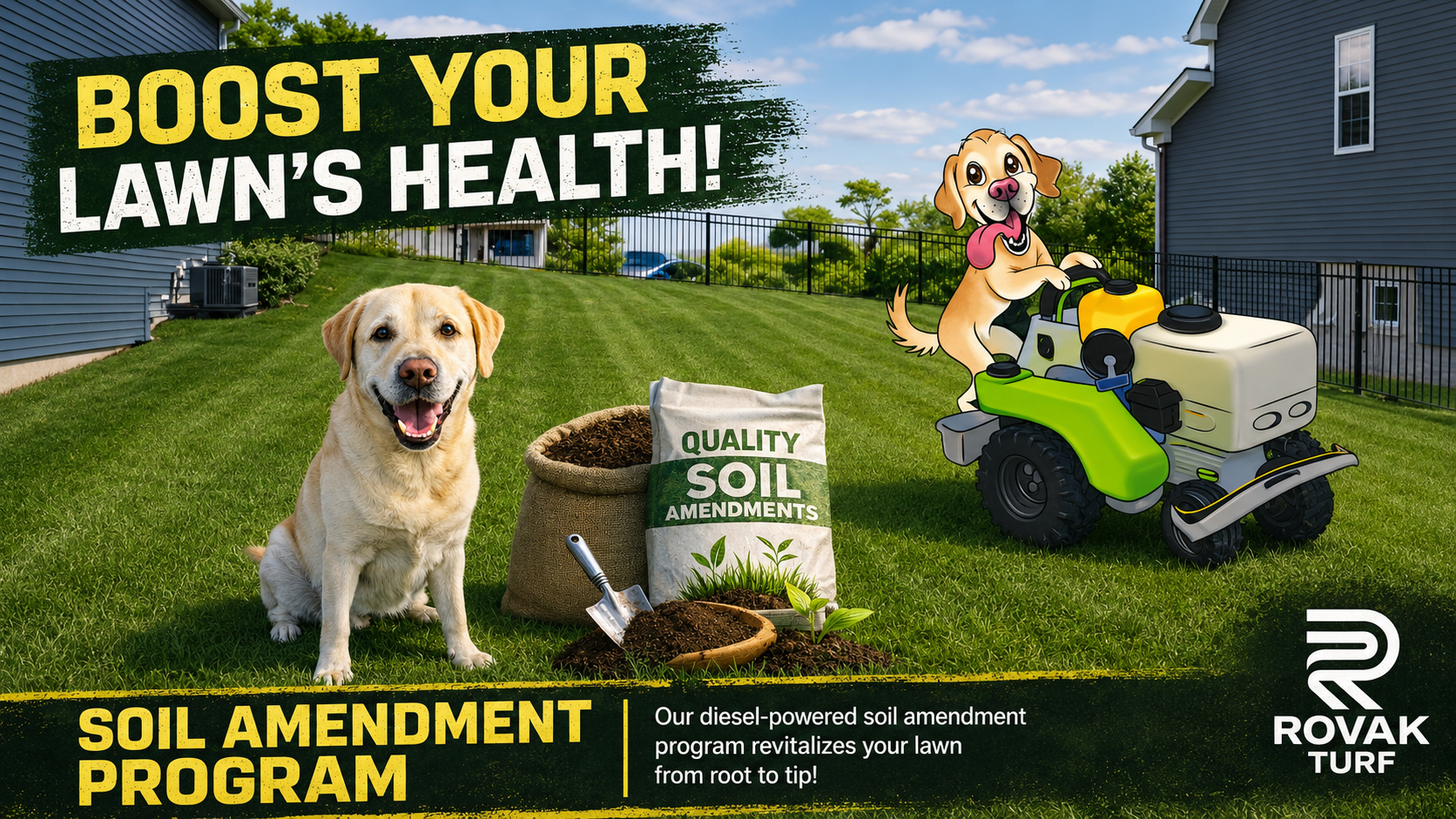
How Rovak Turf's 3-Step Soil Amendment & Conditioning Program Builds Healthier Lawns from the Ground Up in the Western Chicago Suburbs
If you've ever stood in your yard after a heavy spring rain in Yorkville, Oswego, or Plainfield and watched water pool on top of your lawn instead of soaking in — that's not a watering problem. That's a soil problem.
And if you've ever poured fertilizer on a tired-looking lawn and gotten a mediocre response, that's the same story. The grass on top is only as good as the dirt underneath.
The western Chicago suburbs sit on some of the most agriculturally famous soil in the country — but the lawns built on top of that ground are a different story. Between heavy glacial clay, builder-grade subdivision construction, and freeze-thaw winters that compact the ground year after year, your lawn is fighting an underground battle most homeowners never see.
That's exactly what our 3-Step Soil Amendment & Conditioning Program is built to fix.
The Soil Story Under Your Lawn
Most of Kendall, Kane, and Will County sits on soils derived from glacial till and loess deposits. The headline names are familiar to local farmers — Drummer silty clay loam (the official state soil of Illinois), Elburn, Saybrook, Lisbon, and the Kendall series itself. What they all share is a lot of clay and silt, and not a lot of natural drainage.
A few things that make local soil tricky for homeowners:
1. It's clay-heavy. Native subsoils in our region typically run 10–30% clay or more. Clay holds nutrients well, but it also compacts easily, drains slowly, and locks roots out when it dries hard in summer.
2. It often leans alkaline, not acidic. This surprises people. Most lawn-care advice you read online is written for the East Coast, where soils are naturally acidic and lime is the default fix. In our area, the underlying glacial materials are often neutral to moderately alkaline — meaning high pH is the more common issue. Throwing lime on a Yorkville lawn that already sits above 7.0 makes things worse, not better. You'd actually want a sulfur-based acidifier to bring it down.
3. New construction made it worse. This is the big one. If your home was built in the last 20 years anywhere in the growth corridors of Oswego, Yorkville, Plainfield, or Shorewood, here's what almost certainly happened: builders stripped the top two to three feet of topsoil, graded the lot with heavy equipment, then rolled out a thin layer of soil and sod over what's essentially compacted clay subsoil. The grass looked beautiful for the first season. Then year three hit, and you started wondering why nothing you do works.
4. Freeze-thaw cycles never give it a break. Our winters cycle through freezing and thawing dozens of times. Each cycle pushes soil particles tighter together, especially in clay-heavy yards. By the time spring rolls around, the top six inches of your lawn's soil structure is denser than it was the previous fall.
The result is a lawn growing in a thin layer of decent dirt sitting on top of essentially compacted concrete. Fertilizer washes off. Water pools. Roots stay shallow. Heat-stressed grass goes brown in July, and you blame the weather.
Why "More Fertilizer" Isn't the Answer
Here's the thing fertilizer companies don't want to say out loud: nutrients only matter if the soil can hold them and the roots can reach them.
That second part is determined by something called Cation Exchange Capacity (CEC) — basically, the soil's ability to grip onto nutrients so they're available when your grass needs them. Low-CEC soils are a sieve. Fertilizer goes in, rain comes, and most of it ends up in the storm drain heading toward the Fox River. You paid for nutrition your lawn never got.
Compacted clay has the opposite problem. There's CEC there, but the roots can't physically grow deep enough to access it.
Both problems get solved at the soil level, not the surface level. And that's what amendment and conditioning actually do.
Our 3-Step Soil Amendment & Conditioning Program
Step 1: Soil Analysis & Preparation
We start by figuring out what your soil actually is, not what we assume it is. Two yards on the same Oswego street can test wildly differently — one might be sitting on original prairie loam, the next might be sitting on fill dirt the developer trucked in from somewhere else entirely.
A proper soil test tells us pH, nutrient levels (nitrogen, phosphorus, potassium, plus micronutrients), CEC, and organic matter percentage. From there, we build a custom plan instead of throwing the same products at every lawn.
Most local lawns we test fall into one of three buckets:
High pH (above 7.0) — needs an elemental sulfur acidifier, typically 10–15 lbs per 1,000 sq ft
Low pH (below 6.0) — needs a calcium-based lime to raise pH and reduce excess hydrogen that damages roots (less common here, but it happens in older lawns with heavy maple cover)
Low CEC / low organic matter — needs compost, humic acid, and biochar to rebuild the soil's nutrient-holding capacity
Step 2: Nutrient Enrichment & Conditioning
Once we know what the soil needs, we apply a premium blend of conditioners targeted to the actual problem. Depending on the lawn, this can include:
Compost to add organic matter, microbial life, and improve structure
Humic acid to boost nutrient retention and stimulate biological activity
Biochar for long-term improvement in soil structure and microbial habitat
Gypsum to break up compacted clay (this one is huge in new-construction subdivisions — gypsum adds calcium and helps clay particles flocculate so water and roots can actually move through)
Sulfur or lime, based on the pH correction needed
Peat moss in select cases for water retention and aeration
This isn't a one-size-fits-all bag of "soil builder" from the big-box store. It's a calibrated mix matched to what your lawn was actually missing.
Step 3: Root Stimulation & Long-Term Support
The final step is about depth and durability. Healthier soil only matters if your grass roots take advantage of it.
Cool-season grasses common across Chicagoland — Kentucky bluegrass, perennial ryegrass, turf-type tall fescue, and fine fescues — all benefit from deeper rooting. Deeper roots mean better drought tolerance in July and August, less heat stress, and faster recovery from foot traffic, pet damage, or that 4th of July party that wrecked the backyard.
This step uses targeted root-development products and biological stimulants that encourage roots to push down into the conditioned soil below. Combined with our optional Aeration & Overseeding service, this is where the lawn actually transforms.
Why This Matters for Western Suburb Homeowners Specifically
A few honest reasons this program is worth thinking about if you live in our service area:
You probably have new-construction soil. Kendall County is one of the fastest-growing counties in Illinois. If your home is less than 25 years old, your "topsoil" is almost certainly thin, and your subsoil is almost certainly compacted. Amendment is the only way out.
Standard lawn care plans don't fix this. The typical six-step fertilization program treats the surface. It can produce a green lawn on bad soil temporarily, but it'll never produce a great lawn on bad soil. Amendment is the foundation everything else builds on.
You'll spend less long-term. A healthy soil profile holds onto the fertilizer you apply, which means less product waste, less water waste, fewer corrective treatments, and fewer dead patches you have to overseed every fall.
HOA-friendly results. For Plainfield and Naperville neighborhoods with strict appearance standards, soil amendment is what separates the consistently-good lawns from the consistently-struggling ones on the same block.
Pair It With Aeration for Maximum Impact
Soil amendment works best when the soil can actually receive what we're applying. That's why we usually recommend pairing Step 2 with core aeration — pulling thousands of small plugs out of the lawn opens channels for compost, humic, biochar, and gypsum to reach the root zone where they do their work. Done together, the two services compound each other dramatically.
Ready to Stop Fighting Your Soil?
If your lawn looks tired no matter what you do, the answer is probably six inches below the surface. The 3-Step Soil Amendment & Conditioning Program is designed for Yorkville, Oswego, Plainfield, Shorewood, Naperville, and the surrounding communities — built around the actual soil conditions homeowners deal with here, not generic national advice.
Request a Free Quote or call us at (630) 538-4069. We're a family-owned, locally trusted, 5-star rated lawn care company — and we'd love to take a look at your lawn.
Rovak Turf serves Yorkville, Oswego, Plainfield, Shorewood, Naperville, and surrounding communities in the western Chicago suburbs. Voted Best Landscaping Company in Kendall County (Best of the Fox, 2024 & 2025).