
Why Fall Aeration & Overseeding Is the Single Best Thing You Can Do for Your Yorkville, Oswego, or Plainfield Lawn
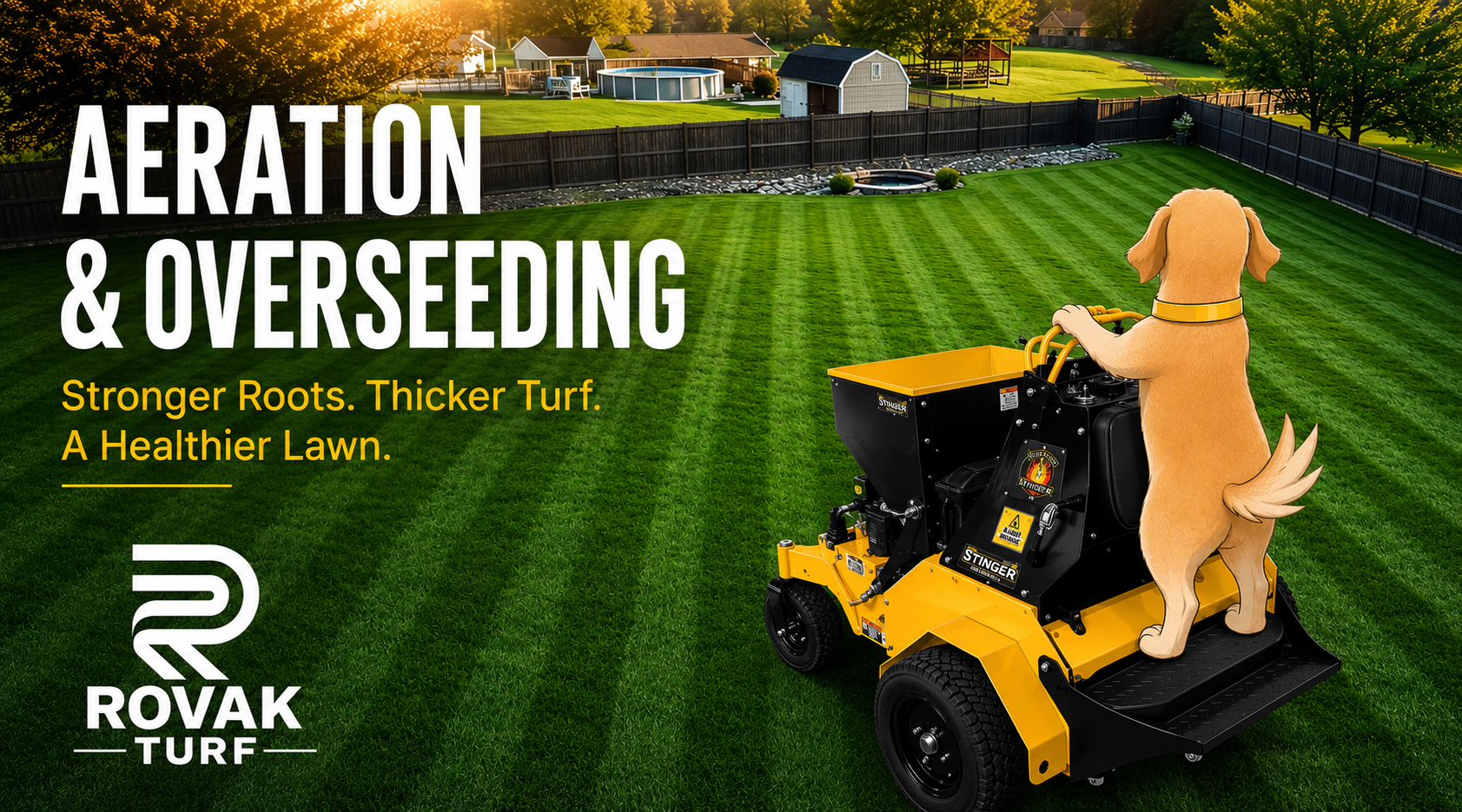
If you only do one professional lawn service each year, make it aeration and overseeding — done in the fall.
That's not marketing talk. It's the underlying truth of every consistently great lawn in Yorkville, Oswego, Plainfield, Shorewood, and Naperville. The homeowners with the thickest, darkest, weed-free lawns on the block almost universally have one thing in common: they aerate and overseed every fall.
The homeowners whose lawns thin out a little more every year, who fight crabgrass every spring, who wonder why fertilizer doesn't seem to work anymore — they usually don't.
Here's why it matters so much, why fall is the only time to do it right in our climate, and what actually happens during the process.
The Two Problems Every Local Lawn Has
Almost every established lawn in the western Chicago suburbs — regardless of how well it was cared for — accumulates two problems over time.
Problem 1: Compaction. The clay-heavy soils in Kendall, Kane, and Will County compact easily. Foot traffic, pets, mower weight, seasonal freeze-thaw cycles, and — for anyone living in a newer subdivision — the builder-grade construction underneath your grass all press soil particles tighter together year after year. Compacted soil chokes out roots, blocks water absorption, and prevents fertilizer from doing its job. If you've read our post on why local soil needs amendment, this is the same underlying story.
Problem 2: Thinning. Cool-season grasses like Kentucky bluegrass, perennial ryegrass, and fescues all die back a little each summer. Heat stress, disease pressure, foot traffic, pet damage, and drought all take their toll. Without regular reseeding, small bare spots and thinning areas open up — and where turf gets thin, weeds move in. Every crabgrass and dandelion problem starts with a thin lawn.
Aeration and overseeding solves both at the same time. It's the only routine service that does.
What Aeration Actually Does
Core aeration uses a machine to pull thousands of small plugs of soil out of your lawn — typically 2 to 3 inches deep, spaced a few inches apart. Those plugs get left on the surface to break down naturally (yes, they look messy for a few days — that's how you know it worked).
What those holes accomplish underground is the whole point:
Water penetrates deeper instead of running off compacted soil
Oxygen reaches the root zone, which grass roots need almost as much as water
Fertilizer and soil amendments finally get to the roots instead of sitting on the surface
Roots grow deeper and stronger because the physical barrier has been broken up
Thatch decomposes faster because microbes get the air they need to work
Water and nutrient retention improves dramatically in the top 4–6 inches of soil
The difference is measurable. A properly aerated lawn absorbs rainfall at 2 to 5 times the rate of a compacted one. That means less runoff, less standing water, less fertilizer waste, and better drought tolerance the following summer.
Aeration also happens to be the ideal preparation for overseeding — those thousands of little holes create perfect seed-to-soil contact, which is exactly what new grass seed needs to germinate.
What Overseeding Actually Does
Overseeding just means spreading new grass seed across an existing lawn — usually right after aeration, so the seed can drop into the aeration holes and make direct soil contact.
The benefits build over years:
Thickens thin areas before weeds can move in
Fills small bare spots without full renovation
Introduces newer grass varieties — modern cultivars have better disease resistance, drought tolerance, and color than what was planted 15 or 20 years ago
Improves genetic diversity — a lawn with multiple grass varieties handles stress better than a monoculture
Reduces weed pressure naturally by outcompeting weed seeds for space
Illinois Extension recommends specific seeding rates for cool-season grasses when overseeding:
Kentucky bluegrass: 1.5 lbs per 1,000 sq ft
Perennial ryegrass and fescues: 3 to 5 lbs per 1,000 sq ft
Bare spots: use the higher new-lawn rate (roughly double)
Most professional overseeding in our area uses a blend — often Kentucky bluegrass for its self-repairing rhizomatous growth, mixed with perennial ryegrass for quick establishment or turf-type tall fescue for drought and disease tolerance. The right blend depends on your yard's sun exposure, foot traffic, and shade patterns.
Why Fall Is the Only Right Answer
Aerating and overseeding in spring feels intuitive — the grass is waking up, why not help it along? Here's why every turf professional in this climate will tell you to wait until fall instead.
1. Weed pressure is the opposite of what you want in spring. Crabgrass and other summer annual weeds germinate as soil temperatures warm in April and May. Aerating opens up thousands of ideal weed germination sites at the exact moment weed seeds are ready to sprout. And overseeding in spring means you can't apply crabgrass pre-emergent — the same barrier that stops crabgrass would also stop your new grass seed. You end up with a crabgrass explosion.
2. Fall has warm soil and cool air — the perfect combination. Grass seed germinates based on soil temperature, not air temperature. In late August and September, soil temperatures in the western suburbs sit in the 60s and low 70s — ideal for cool-season germination. Air temperatures start to drop, evaporation slows, and the young grass gets a long, low-stress runway to establish before winter.
3. New seedlings get two full growing seasons before their first summer stress. Seed planted in September establishes through fall, roots deeply through winter, gets a full spring of vigorous growth, and doesn't face its first real summer heat until it's essentially a full year old. Spring-seeded grass gets weeks — not months — before summer hits.
4. Fewer weed competitors. Late-summer and fall weed pressure is much lower than spring. Your new seed doesn't have to fight for space.
The Local Timing Window
For the Rovak service area, the ideal aeration and overseeding window is mid-August through mid-September, with a hard back-end deadline of late September for most homeowners.
Here's the math: cool-season grass needs about 45 days to establish before the first frost. The first light frost in the western Chicago suburbs typically hits around October 22, with the first hard frost usually arriving in early November. Working backward from October 22, that puts the last safe seeding date around September 5 to 10 — earlier for tall fescue, which takes longer to develop cold hardiness.
Bluegrass in particular is slow to germinate — 2 to 4 weeks before you'll see growth. Rushing into late September or October seeding means young grass gets caught by winter before it's ready.
There's also a local ordinance consideration: most cities in our service area (Yorkville, Oswego, Montgomery, Naperville) prohibit new lawn installation from July 1 through August 31 to conserve municipal water during peak summer demand. For overseeding into existing turf, standard watering rules typically still apply — but if you're doing a full renovation or laying sod, that window is blocked. Something to know if you're planning a bigger project. (More on watering practices in our post on smart lawn watering in Yorkville, Oswego, and Plainfield.)
Practically, most of our aeration and overseeding work happens between August 20 and September 30. Book earlier rather than later — fall calendars fill up fast every year, and the difference between mid-September and mid-October seeding can be the difference between a lawn that thrives next spring and one that limps into summer.
Watering After Overseeding: This Is Where People Fail
Overseeding is only as good as the watering that follows it.
New seed needs consistent moisture for germination. That means light, frequent watering — the opposite of the deep, infrequent watering we recommend for established lawns. Here's the schedule that works:
First 10–14 days: Light watering 2 to 3 times per day, just enough to keep the top half-inch of soil moist. Don't let it dry out.
Days 15–21 (once grass reaches about an inch): Reduce to once per day, slightly deeper.
Days 22–30: Transition to normal deep watering (about a half-inch, 2 to 3 times per week).
Day 30 onward: Standard established-lawn watering schedule.
City ordinance considerations matter here. Yorkville, Oswego, Plainfield, Montgomery, and Naperville all offer expanded watering permits for new seed and sod — typically allowing daily watering for the first 8 to 10 days. You must apply for the permit before installation. Fines are real, and enforcement is active. We can help you with the paperwork if you're not sure where to start.
What Aeration and Overseeding Pairs With
Aeration is powerful on its own, but it also creates the perfect access window for other services that penetrate the soil:
Soil amendment and conditioning: The aeration holes are ideal channels for compost, humic acid, biochar, and gypsum to reach the root zone. Combining amendment with aeration compounds the results dramatically.
Soil testing: Late summer is the perfect time to test — the results guide any pH corrections or nutrient adjustments before winter dormancy.
Fall fertilization: A late-season fertilizer application after aeration reaches the roots directly, feeding the plant right when it's building winter energy stores. This is arguably the single most important fertilizer application of the year.
Dethatching: Lawns with more than ½ inch of thatch should be dethatched before aeration so the aerator can reach clean soil.
Stacked properly, a single fall service visit sets up your lawn better than a full season of surface-level treatments.
Signs Your Lawn Needs Aeration This Fall
If any of these apply to your lawn, it's a strong candidate for aeration:
Water pools or runs off during rain or irrigation
Grass thins out despite consistent fertilization
Bare or worn spots that don't fill in on their own
Your home was built in the last 20 years (builder-grade soil is almost always compacted)
Heavy foot traffic, kids, pets, or backyard entertaining
You've never had it aerated, or you can't remember the last time
Screwdriver test: if you can't easily push a long screwdriver 4 inches into the ground when the soil is moderately moist, you're compacted
Honestly, most established lawns in the western suburbs benefit from annual fall aeration. Every-other-year is a bare minimum for lawns with low traffic and good underlying soil. For anything on clay or builder-grade fill, every year is the answer.
Bottom Line
Aeration and overseeding is the single most valuable investment you can make in your lawn each year — more impactful than any single fertilizer application, more foundational than any weed control treatment, and more durable in its effects than almost anything else you can do.
Done right, in the right window (mid-August through mid-September for our area), paired with the right follow-up watering, it thickens your lawn, breaks up compacted soil, refreshes your grass genetics, and sets you up for a spring that starts ahead of every neighbor who skipped it.
Done wrong, in the wrong season, or with poor follow-through — it's wasted money.
Ready to Book Fall Aeration & Overseeding?
We're a family-owned, locally trusted, 5-star rated lawn care company serving Yorkville, Oswego, Plainfield, Shorewood, Naperville, and surrounding communities. Fall calendars fill up quickly — the earlier you book, the better the window you'll get.
Request a Free Quote or call us at (630) 538-4069.
Rovak Turf serves Yorkville, Oswego, Plainfield, Shorewood, Naperville, and surrounding communities in the western Chicago suburbs. Voted Best Landscaping Company in Kendall County (Best of the Fox, 2024, 2025, & 2026).